

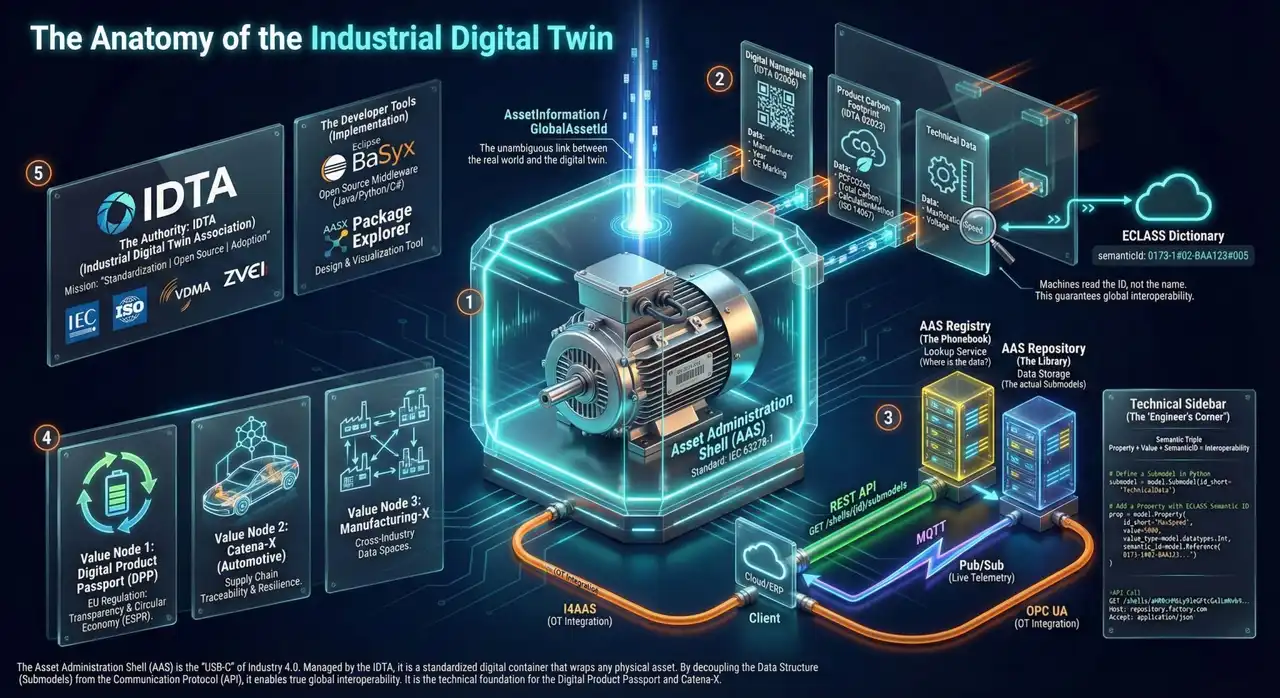


This fundamentals training offers an easy introduction to the world of HTTP services and how to use them in SAP ABAP. As a practical example, the integration of the digital twin based on the Asset Administration Shell is used.
Description
For the integration of external systems, file interfaces, IDocs, BAPI/RFC and similar approaches have often been used in the past. The modern ABAP world relies primarily on the OData protocol, which unfortunately cannot always be used. Here, the HTTP support integrated in ABAP offers an interesting alternative that is even available in older SAP releases.
This fundamentals training offers an easy introduction to the world of HTTP services and how to use them in SAP ABAP. We use the digital twin as a practical example to teach bidirectional integration via modern JSON REST APIs. Participants receive additional guidance for their own integration projects.
Practical scenario "Digital twin"
As a practical scenario, we use the digital twin known from Industry 4.0 initiatives. More precisely, the "Asset Administration Shell" based on Eclipse Basyx, an open source implementation of the "Asset Administration Shell" (AAS). These are all terms from industry that are largely unknown in the SAP environment but not uninteresting.
In our blog we have explained the concept of the Asset Administration Shell. The Asset Administration Shell is the basis for the Digital Product Passport, which will be mandatory for some industries in the coming years. This makes the Asset Administration Shell technology relevant for many SAP customers as well.
Delivery options
We offer this training as a company training. Either as a two-day on-site training at the customer's premises or remote. For remote trainings, the content can be distributed over several days in 4-hour blocks by arrangement.
The training takes place on the customer's SAP ABAP systems. These must meet the system requirements.
All developments are retained after the training. Additional materials are provided via the Brandeis training portal, to which access is also retained after the training.
Configuration options
At the end of the training we have scheduled time to allow room for questions on practically relevant topics and to give guidance on projects. By default, we show the integration of the Digital Product Passport with SAP ABAP here. Changes for company trainings are possible after prior agreement.
For company trainings, we are generally also able to cover other scenarios or incorporate content from other Brandeis trainings.
Links:
- Image credit
- Brandeis blog "What is an Asset Administration Shell?"
- Fraunhofer blog "What is a Digital Product Passport?"
- Fraunhofer homepage Eclipse Basyx
Agenda
- Introduction to HTTP services
- Tools for developers
- Introduction to the digital twin: architecture of Asset Administration Shells
- API First: REST API, OpenAPI, Swagger
- ABAP HTTP Connectivity - client and server
- SAP as a data provider
- SAP as a data consumer
- Real-time scenarios
- Integration of open source components (e.g. abapGit, JSON)
- Clean Core aspects
- Practical scenarios: e.g. Digital Product Passport
- Suggestions and tips for your own projects
About open training
Wir informieren auf unserer Homepage https://www.brandeis.de/events/ über geplante Termine für offene Schulungen - remote oder vor Ort. Bei Interesse bitte Kontakt aufnehmen. Wir nehmen Interessenten an offenen Schulungen in einen Verteiler auf, um aktiv über anstehende Termine zu informieren.
Die Teilnehmer von offenen Schulungen müssen ihre eigenen SAP ABAP Systeme mitbringen, welche die Systemvoraussetzungen erfüllen müssen. Es werden ggf. weitreichende SAP Basis Berechtigungen benötigt. Für den Zugriff auf die eigenen Systeme über WLAN/VPN sind die Teilnehmer zuständig. In den meisten Fällen ist ein Gäste-WLAN o.ä. am Veranstaltungsort verfügbar.
Prerequisites
The exercises were prepared for S/4 HANA 2023 (ABAP Stack 7.58). For company trainings, they can be adapted for older releases on request.
Extensive SAP Basis authorizations may be required for the configuration (e.g. SM59, SICF, STRUST).
Participants need an installed Eclipse environment including the ABAP Development Tools (ADT) and should be able to install additional development-related tools when needed: e.g. Notepad++, Postman, Bruno, Visual Studio Code, Docker.
Target group
ABAP developers, integration consultants